
Ep 195: Integrating East Asian Medicine in Fertility Care with Dr. Ting Wu
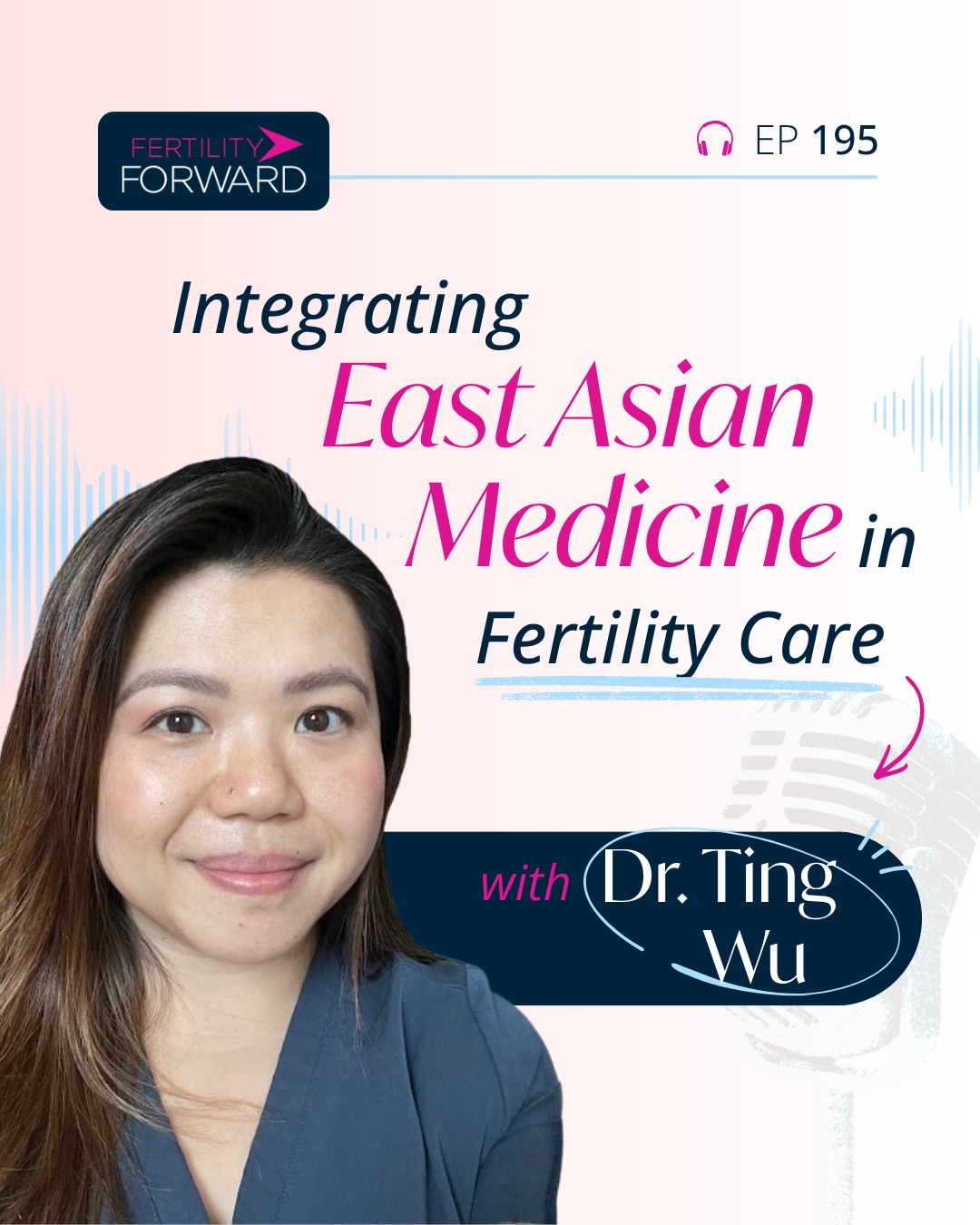
Fertility Forward Episode 195:
How do we bridge the gap between Eastern and Western medicine and create a holistic approach to patient care in order to get the best possible fertility results? Today on Fertility Forward, we welcome the founder of NYC Acupuncture + Wellness, Dr. Ting Wu, to discuss her integrative East Asian medicine approach to women’s health, fertility, and reproductive wellness. Tuning in, you’ll hear all about how research and perception of East Asian medicine have changed over the last decade, her unique approach to HPA (Hypothalamic-Pituitary-Adrenal) axis and how it helps with fertility issues, and more! We delve into how Dr. Wu is working to bridge the gap between Eastern and Western medicine within her patient care and the power of collaboration, before discussing the importance of listening to your own body above anything else when it comes to your health. Our guest even challenges us to do an internal audit of our lives. Finally, and as always, we all talk about what we are grateful for today. Thanks for listening!
Rena: Hi Everyone. We are Rena and Dara, and welcome to Fertility Forward. We are part of the wellness team at RMA of New York, a fertility clinic affiliated with Mount Sinai Hospital in New York City. Our Fertility Forward podcast brings together advice from medical professionals, mental health specialists, wellness experts, and patients because knowledge is power and you are your own best advocate.
Dara: Hi everyone. So today on our podcast, we are so lucky to have Dr. Ting Wu, who is the founder and CEO of NYC Acupuncture Wellness, where she specializes in women's health, fertility, and reproductive wellness through integrative East Asian medicine. In her practice, she works with women and couples who are trying to conceive naturally, preparing for IUI or IVF, and recovering from pregnancy loss. She also helps patients with hormonal imbalances, seeking support for conditions such as PMOS, endometriosis, and irregular cycles. Thank you so much for being here today.
Dr. Wu: Thank you so much for having me. It's lovely being here.
Dara: It's been so nice. We were chatting a little bit beforehand. We share a love of cats, which Rena was not, did not hear. Rena's a dog lady, which we will not fault her for. I like dogs too.
Dr. Wu: Absolutely. I grew up with dogs, they're lovely.
Rena: Well, I just love that you also say that you're CEO. I'm all about being the CEO of your own life.
Dr. Wu: Well, yeah. Yeah, take the power onto yourself, right?
Rena: That's right.
Dr. Wu: Yeah. Well, thank you, ladies, so much for having me. I feel like it's been lovely to even conversate with you and actually like meet fellow professionals that even want to have this conversation. Like we were talking about earlier. Like if this is between medical professionals, the East and West, this wasn't a conversation we would have had a decade ago, really, right? Or very few conversations.
Rena: Well, and maybe tell us for you too. I think that's a great entry point. You've been doing this for a long time. You're an expert in your field. Have you found that it was hard to even break into sort of getting your perspective and your approach into Western medicine? And has that been a barrier for you?
Dr. Wu: Well, I would say, like we were talking about earlier, if this was a decade ago, we would have absolutely and still sometimes been as an East Medicine practitioner and acupuncturist, I would have been the very last line of what a patient would have sought out, right? They would have tried everything under the sun. And if they still weren't having results, they'll be like, oh, let me try this, like hail Mary, and go to this acupuncturist that somebody had told me about, right? And now, 10 years later, right, I'm seeing patients earlier and earlier on in their fertility journey, right? Just because we're, I guess everyday people are finding more about East Asian medicine, they're finding more about acupuncture. And now I'm seeing patients as early as like, hey, I just want to regulate my menstrual cycles. I get really, really bad cramps. And I'm thinking about potentially starting a family in a year, and I want to be prepped for it. So that's a huge mindset change in even the patient from the patient level. And that has translated all the way through fertility specialists of like, hey, this is what my patients are asking me about, right? And this is something that when on now when I go in, they're like, oh yeah, my patients have been telling me about this. Like, I want to have this conversation. So that's been a huge change for the past decade.
Sara: I think it's also interesting that, you know, and this is my limited knowledge way back when was okay, acupuncture, when you're really in pain, it could help with pain. I guess my limited knowledge when I first heard about acupuncture was, you know, there was a small window for what it could be beneficial for. And this is what I'm still so impressed and surprised that I feel like every year I'm hearing how it could really be helpful for so many different conditions. So, like, you know, sleep. It makes sense for endometriosis, but the fertility angle was still something that didn't fully make sense, or even how it could help hormonally.
Dr. Wu: Yeah, I mean, so the hard part about translating East Asian medicine, because we are translating essentially historical data of like over 2,000 years of case studies, which a lot of it is traditional Chinese, Korean, Japanese, right? So we're essentially translating that data and finding correlation of like how can we test this? Because even five years ago, when we were testing acupuncture with sham acupuncture, the results were like, oh, it doesn't matter if you use acupuncture or sham acupuncture, because they're finding the way they were stimulating the body with sham acupuncture actually were on the same meridian pathway.
Rena: Wait, what's sham acupuncture?
Dr. Wu: So in research, sham acupuncture is a way that they're trying to test the body of like, hey, if we don't use this specific acupuncture point to stimulate the body, what if we went down the chain? What if we use a different area to try to convince the patient that they're still getting acupuncture?
Rena: Oh, so like a placebo.
Dara: Yeah, placebo effect.
Dr. Wu: So they would have a control of patients that are not getting acupuncture, they would have sham acupuncture as a control, and they would have real acupuncturists doing real acupuncture. And then what they were finding that these tests were not well controlled because even the points that they were using for the sham acupuncture might be on the meridian line, they might be still stimulating the body in a different factor. So now, even in research, they're getting much, much better about how do they do sham acupuncture and getting some real tests, getting a real control, right? So even the research within the past 10 years have started shifting on how they try to modify sham acupuncture to have a real control, right? And that goes to show you also how the East and Western doctors have not been able to communicate effectively because we didn't even have a common language to communicate upon, right? Other than just patient experience, right? But ultimately, patient experience is the thing that we're trying to help, right? And their outcomes. So I feel like there is an aspect of acupuncture can be so broad because it is a whole entire medicine for treatment, right? East Asian medicine will use acupuncture, everything like pain that you mentioned, right? Like the back pain is well studied, right? But you know, like knee pain, like cervicology, like you know, all these different other aspects. And now more and more studies are going into fertility as well. So this is we're talking about internal medicine now. And I think one of the more recent studies, studies about the HPA access, right? So the hypothalic, pituitary, adrenal access, and we're talking about something that gets dysregulated from chronic stress, right? And with that dysregulation, we're talking about inflammatory factors, we're talking about dysregulation and eliminating waste, obviously the big cortisol that everybody's afraid of, right? How acupuncture can help in that way is that we're known to decrease inflammation, we uh up the circulation, we are able to essentially speak to that HPA access, right? And so if you're reducing the stress, you're helping your body to toxify, and how that translates into a metabolic process. I mean, I'm sure you can speak to how essential and foundational this is to fertility, right? And that's how we've been able to help patients in their fertility journey by managing that HPA access.
Rena: Have you also found that over time, as maybe the dialogue or the understanding has become more and more about understanding the importance of acupuncture, that your patients are also more long-term. I've noticed in my practice that patients come for a reason. You know, I always say on an intro call, no one says, oh, I'm super happy today. Let me find a therapist so I can talk about how happy I am. Right? You know, and I imagine same for acupuncture. No one's like, I'm feeling so great today. Let me go get some acupuncture. But I've at least found in the past few years that I think that the general population is at least having a better understanding of just sort of like I want to have these practices on an ongoing basis. And so I find, you know, my patients, they just stay and they, you know, we're just kind of going through life together. And have you found that people are staying in acupuncture more long-term and more consistent? You know, maybe they come to you for fertility, but then they stay because they see the benefits, right? You know, anti-inflammatory, circulation, stress, all the things.
Dr. Wu: Yeah. I mean, I have a really core group of essentially women athletes, right, that are aging, right?
Rena: Oh, hi, right here.
Dr. Wu: I mean, like, hey, hello, right? So there's a lot of patients that are coming to me, not only for period regulation, everything from my sport to compete has me cutting weight a lot. Over time, that has dysregulated my menstrual cycle, right? And for whatever reason, if they've had bad experience with birth control or anything, they're seeking a different type of treatment to help them to their obviously their fertility journey, but also I'm so mad at my hip because it's bothering me and I can't work out the way that I used to. I can't perform the way that I used to. I can't do the thing that helps me stress relief because of this pain. And that's adding even more to their plate of, let's say, their fertility journey, or even just, you know, work, right? They don't have that physical mental health practice anymore. Right. So yeah, I'm absolutely seeing patients for longer within their entire lifespan, really, and to help them ease those kind of things that are preventing them from even self-regulating.
Rena: Well, I think it's so important to note, you know, patients are made up of so many aspects, right? And I always say to a new patient in my practice, right, like, sure, we're gonna first start out, we're gonna talk about why you're coming, right? Which is fertility. But then my goal for you is that this becomes a piece of your life, not the whole, because your life is made up of so many other things in addition to this. And so it sounds like you have the same approach that, okay, this is a piece of your life. And I know that you can recognize that, especially if I'm an athlete and running is my coping mechanism, that if I have pain in my foot and I can't do that, how that's then gonna have a ripple effect onto all the other areas of my life, right? Because if I don't have that, which makes me feel good mentally, the rest of the areas of my life are gonna suffer because I don't have that core piece of myself that grounds me and enables me to show up in the way that I want to.
Dr. Wu: Yeah, yeah. And it's huge because especially something that could be even a core part of your identity, right? Like there are people that not only is it a mental health, physical health practice, it's a core part of them. So if they're not able to do it, then they start having depressive, anxiety, different kinds of things that when that foundational aspects of you get disrupted. So, of course, we would have to change our treatment methodology to help them in that period of life that they're going through, right? Until they can self-regulate.
Rena: Exactly.
Dara: So, in terms of you work with a variety of patients, and as you mentioned, you really enjoy meeting with women prior to having to potentially go through a fertility treatment. I would love to walk us through in terms of so you said you work with patients sometimes hormonally to help regulate their menstrual cycle. This is where I'm still super curious because I would love to see the, and we're seeing a little bit more that merge between the Eastern and Western medicine, but do you communicate with doctors? Like what's your connection? How do you kind of bridge that gap?
Dr. Wu: If they're currently ongoing fertility treatment, like IVF or IUI, yes, we're communicating with the doctors, we're emailing back and forth, right? To the level that the patient is comfortable with, right? I also have patients that are like, you know what? I'm just here because it's so much. I don't want to talk about it. And they'll ask me questions along the way, but they'll be like, I just don't want to talk about it right now. Fair, right? I'm also meeting patients at where their comfort level is at the moment, right? Because if I'm, I don't know, helping a 30-year-old with let's say they want to freeze their eggs, right? Because they're not ready to start a family yet, and they just want that, they want that security feeling. They're gonna have completely different needs than say my patients that are in their early 40s and they're like, I need to get pregnant, right? So they're gonna have very different questions, very different needs, different types of communication levels that they even want me to communicate with their doctors, right? And so my number one priority is like, hey, what does the patient need at this moment, right? I'm gonna meet them there. If the patient wants me to communicate, absolutely, we are emailing back and forth. I mean, even as much as what is the ultrasound follicular monitoring showing, right? Like, how do we alter our treatment depending on that? Right? What are the timing of everything depending on what their hormonal levels are saying? Like, when do we alter the trigger shots and all of that? I'm adjusting all of my treatments depending on that for the patient, right? And when we're really, really early on, right, I have fewer patients in general, let's say menstrual cycle, mid-20s, that are wanting me to talk to their gynecologist about, oh my god, my menstrual cycle is regulated, but I have these incredible painful cramps, right? And I don't want to just be popping Midol for the rest of my life. I find that patients are like, oh, okay, like whatever you can do, but it's so low on the totem pole of what they are dealing with on a day-to-day. I don't find those requests very often. Now, my patients later on, let's say perimenopausal, menopausal, and let's say they don't want to start a family, right? They're just like, no, I don't want kids, but I'm going through perimenopause and menopause, and this is an upheaval in my life, right? Those patients more than likely will be like, hey, I know I need to get a full hormone panel, right? Can you talk to my functional medicine doctor about this, about what we're doing here? So, in relations to how much communication I have with a Western doctor, it is really dependent on the patient.
Dara: For me, also, I wonder, I think we're I understand that I also wonder with what herbal, do you work with herbs?
Dr. Wu: Yeah.
Dara: That's where I find there's such a disconnect in terms of Western doctors understanding can they be used together? Is it contraindicated because maybe they might be working the same thing? Is that something that you're familiar with in terms of is it kind of an integrative discussion?
Dr. Wu: Yeah, yeah. I think it's hard to get into the nuance of it because there's so many herbs and there are contraindications. And I would say as a blanketed statement, right, we typically go very conservative in the midst of IUI, IVF treatment, right? Because if you are getting external hormones, right, herbs, depending on the formula, sometimes they take a while to start working. And if you're getting external hormones at a decent level, right, we don't know when that's going to transfer, right? When that's gonna peak over what your optimal level is. So generally, what most East Asian medicine practitioners will do is get the patients off herbs during that part, right? Just so we can minimize different types of herb medicine interactions, right?
Dara: But you're priming the body beforehand? You can still work with getting them to a good level prior to potential treatment.
Dr. Wu: Yeah, yeah. I'll throw out some TCM terminology, right? A common one is liver cheese stagnation, right? Sometimes practitioners will tell the patient what that is, and a lot of times they'll get formulas for that. And essentially, it's not necessarily directly the liver organ, but it's the liver meridian channel that we are utilizing. So if we're talking about symptoms, we're talking about irritability, maybe physical tension and tightness that they can't ever quite release and stretch out, right? It kind of closely mirrors volatile cortisol peaks, right? And in that mid-phase of dysregulation for the HPA axis that we're talking about, it kind of mirrors that. So there are formulas that we can give the patient to help regulate that and control that. So if that is one of how they're presenting to us, that's some of the formulas that we might be giving them prepping before an IVF or IVY treatment to help that dysregulation, right? So they're going into treatment a lot more prepped and ready. Now, another one would be kidney yin deficiency. And we see this much more with our older patients, right? And we consider that more chronic stress, right? Over time depleting the body's essences, and we call it generating empty fire. Empty fire is almost like menopausal symptoms, like sweating, feeling hot flashes, right? Getting frozen shoulder because it's not necessarily painful, but there's a dryness and a tenseness into it. So that's more like if we're talking about that same HPA access, like a much more late-stage dysregulation function, right? So not only night sweats, but correlating insomnia and anxiety. So those formulas to help with those symptoms are going to be vastly different than the liver cheese stagnation ones that we were talking about before. So depending on how the patient presents and what they need, those are the types of formulas that we were using and herbal combination we're using for them to prep them for fertility treatments.
Rena: I just wish that, you know, listening to you, Saka, everything you're saying resonates so much. And we'll make the bold assumption that Dara is going to agree with what I say. But, you know, I just, I think all the time when I have patients, just how important a holistic approach is and how modern medicine just is such a disservice to people, right? You go in, you have, let's say, like 15 minutes with a physician, you know, you have your presenting problem, whatever. And they just don't go under the hood of the car, right? To find out all these other factors in your life that may be contributing, right? Like maybe that frozen shoulder you're talking about, you know, and then they say, Well, I'm sorry, I can't find anything, right? There's nothing to do. You're fine. The imaging shows nothing. And then you leave feeling totally gaslit and questioning yourself and all the things instead of right, okay, fine, maybe nothing shows up on image because maybe there's other things going on in my life and it's manifesting in that way. Right. And so I just think it's so important to make sure that you're working with a team of practitioners that ideally can collaborate. You know, it sounds like you really collaborate with physicians. I know that I do too. It just makes it for such a better approach when you can really understand, right? And then, okay, maybe this person might like their diet sucks. You know, maybe you find out they're eating all this garbage. It's like, okay, well, all that sugar you're eating, you know, that's why it's contributing to your inflammation. You know, no one ever asked you about that and provided you education on how to eat optimally, right? You know, it's just there's so much that goes into something. And to really make sure that you're working with people that understand, that give you the time of day, that are open to also saying, like, I don't know, right? You know, and to saying I don't know, but what you're telling me sounds like you're suffering, right? It sounds like you have a lot of pain in your shoulder. I don't know what's causing it. I don't know what is the best treatment, but it sounds like you're really suffering. Here's another thing to consider, right? Instead of just saying, well, okay, must be all in your head, you're totally fine.
Dr. Wu: Yeah. I mean, absolutely. And I think that like we were talking about the dichotomy of like East and Western practitioners, right? I'm happy to see more and more of both sides communicating with each other, right? And Realizing for better patient outcomes, that you know, neither of us know it all, right? And we really work well together. I was thinking of a patient recently that's coming in. She's more like a I'm moving into a menopausal phase and I want help with that. And just like how you were saying, Rena, she had no idea that the sugar that she was eating was creating an inflammatory response, right? And I had to sit down and be like, okay, let's go through all of like what of everything that you're triggering, right? And that was one thing that she was like, oh, I thought fruits were great for me. And I'm like, yes, in general, but you know, if you have a huge bowl of oranges or whatever an hour before bed, you're gonna be inflamed, you're gonna be sweating, you're gonna be peeing, right? Like it's going to disrupt your sleep. And there were things that I could recommend to her as an East Asian medicine practitioner of like, hey, here are some foods that can help make you feel more nourished and feel more sustained, like, say black sesame seeds for her, specifically that kidney yin deficiency we were talking about earlier, to help make her feel like she's had a little bit of a nighttime snack and she can go to sleep without a huge amount of sugar influx. But at the same time, I'm telling her, like, hey, I can give you this information, but you need to see a dietitian, right? You need to see somebody that at this phase where your hormones are fluctuating and you're not sure, I can give you this advice, but you also need this piece too, right? Go to a dietitian, find out about this. So I feel to your point, the holistic view of both sides is great for patient outcomes.
Dara: This is where I would love collaboration. So as a dietitian, I have been trained Western, but I learned something new this evening about like the black. And it actually makes sense. So I often try to think of it with a science mind. You know, the notion of, you know, I've had many patients come to me and say, you know, I was told by my acupuncturist during my cycle when we're priming, prior to IUI, prior to IVF, I should be having a lot of warm foods. And that was nothing that I've been trained in as a dietitian. But of course, my brain goes to, well, that kind of makes sense because warm foods are easier on your digestive track. If your digestive tract isn't having to work so hard with cold foods, cold raw foods, you know, make your body work a lot harder and make a lot of the energy probably divert its attention, which should be down here, to digestion. That definitely makes sense. But again, I wish there was a this is where I'm like, I there's so much potential for this collaboration because the problem is we just don't know.
Dr. Wu: I mean, I feel like it's just a different viewpoint, right? We're for a long time we've been studying different things. And in modern science, we were studying like, hey, what is caloric expenditure, right? And if you like salads and cold foods are healthier because we have a weight issue, an obesity epidemic in America. So it was deemed as healthy food, right? Healthy food is raw food, but it has a higher caloric expenditure because it takes more work for your body to get whatever nutrients you need from it, right? So at a critical time where you need easy nourishing because you're trying to use all of that energy for egg quality, for building the endometrium lining, right? All of that, you don't, it's not healthy to have that high expenditure food to be intaking. So I think it's just a different mindset. And the more we can collaborate, the better information we'll all have for patients.
Dara: It's funny when you were saying that, I was thinking I had a patient last week when you know we were reviewing what she was eating and what vegetables she likes to eat. And she goes, Well, I do like kale. I said, How do you prepare kale? And she says, you know, I just have it raw. And I said during this cycle, it may not be best to have it raw if you're and she was telling me she's suffering with some tummy troubles. And she was like, I thought kale was healthy. And that's something just because something has some health benefits or nutritional benefits doesn't necessarily mean it works for your body, or it works right now, or depending on also the volume, often people think, oh, if something's healthier, I should be having more of it.
Rena: Well, and that's why I hate social media today, because I think that it's I could reveal, like I've been going through sort of my own health journey trying to figure out various food allergies and such, right? And all these things that I thought were healthy for me, kimchi, all these like fermented things are not for me personally, right? But I thought they were healthy for me because that's what kind of generally speaking is supposed to be healthy. And so I think it's so important to stay in your lane, so to speak. And something I always remind people like if that noise gets too loud, you know, you're going on these Reddit threads, chat GPT, all this. It's really time to close yourself in and surround yourself with a trusted team of support advisors, right? And so, like, stay in your lane. What you know, you have your acupuncturist, your dietitian, your therapist, your physician. Okay, that's it. And those are the voices you need to listen to because they know you, they know your body, they know you as an individual. Social media, Instagram, et cetera, they don't.
Dara: I'm gonna add one thing to that, Rena. And the fifth person you should listen to is yourself. Because I do really believe that it's great to have experts in the field, but you are also the expert, I believe, of yourself. You can get all great information, but if it doesn't connect with you, and I think a lot of times we do look outside for information. I think it's great. We also have to look within and get curious with yourself. I think we're looking for the answers and not necessarily asking ourselves, how do I feel when I eat certain foods, when I do this? What are my thoughts about this fertility process? I think that's one element.
Dr. Wu: 100%. I completely agree with what you're saying. I feel like it used to be what was the saying, like, oh, if you Google anything, you have cancer, right? All of my symptoms lead to cancer, right?
Dara: It often does.
Dr. Wu: Yeah. And then now with AI and chat GPT, right, it also becomes information overload if you add in social media, right? Because everybody will be telling you whatever latest and greatest health food of the year or two, right? Be it kimchi, be it whatever the latest thing we think about eggs and dairy, right? And all of that. So to your point, like, yes, it's good to find people that can be part of your team and also intuitively listen to yourself and get curious with yourself. Just because somebody tells you something is good, right? And you're having this experience of like, oh, I'm doing this good thing, but I'm having a different body experience. Like, why is that? What was it? Oh, yeah, the recent, more recent recommendation of heavy lifting for women to increase their bone density. Yes, that's absolutely brilliant. That's great. Women haven't historically been doing that. However, now I'm seeing a lot of women in these like high intensity were going for max weight every single time, and they're coming in with not only like body aches and stuff, but they're like, Why am I overheating now? Oh, I'm like randomly overheating. Like, what is going on with my hormones? And they're like, Oh, I go in and my hormone panel, everything's great, but I'm still like I've never smelled this odor on me before. It was one of my patients then. And we were reviewing some of their exercise things, and I was like, I think this is too much of a cortisol response for you. You're doing high intensity too often, too close together, you're pushing the max a lot, and she's just signing up for class, right? She's like, what? I have like this package to this boot camp class, and I'm going for, you know, I want to maximize it, I want to maintain my weight and all of that, right? So, just like there's customization that we would do for someone in their dietary response or their fertility response, there's even the physical training response because that's input. So, even if you listen to all of the social media fats, you still have to go into yourself and be like, how is this actually feeling in my body?
Rena: Right.That's a great point. And it's okay, so now you've introduced heavy lifting. Well, have you increased how much protein you're intaking? Yeah. Because if you're gonna now lift heavy, you need to up your protein, right? And so exactly, you know, Instagram is not giving you some holistic comprehensive package of right, like if you do this, then that. And so I think it is too, I don't know, it's interesting. I I've really seen a trend the last probably like year, I would say, with my patients being so influenced with noise from social media. And I think this overstimulation and information overload that we were sort of mentioning, and it's it's how to filter that out and how to declutter. Because I think, at least I see from the psych perspective, that's overwhelming people and then bringing them to a place of I'm not doing enough, right? And so to really declutter, streamline, and again, work with people that know you as an individual and can do what's right for you, because what's right for a 20-year-old college student is not what's right for a 45-year-old sedentary office worker, right? It's different.
Dr. Wu: Yeah. And I feel like some things are easily noticeable visually, right? Like if you're trying to get a dermatological beauty treatment, right? Or even buying a serum online. If you see it on a 20-year-old, you're like, well, they could just look like that at any given time, right? I want to see it on somebody my age, like a 40-year-old skin, right? And see if it's working there, right? And that's more of a visual thing. So people understand that through social media, which is very visual, right? But when you're talking about how do I feel in my body, that's self-intuitive work that is not necessarily as visual and as easy to communicate. So, and I think to your point, you have to go inward and do that work as well to because then that will help you filter out the noise.
Rena: Well, and I will use that as a plug for what I was just talking about with a client for the power of disconnection and stillness. And 30 minutes here and there is not the same. Do a silent retreat, do a real disconnect because it's in those periods of stillness that you really are able to check in with yourself. And then it's the way I like to look at it myself is kind of ideally once a quarter. Sometimes it only happens every six months, but take that time. I check in with myself. And then the other few months, right? I work with my people, whatever, that keeps me moving. But then I got to pause, I got to check in. Okay, maybe we got to revamp because who I was six months ago isn't who I am now. Okay, so now I've checked in, I've had this stillness. I can go back to the team of people I work with. Okay, what do we need to change? What's not feeling good? Okay, cool. Let's go, you know, the next few months. Okay, then pause, stop, check in.
Dr. Wu: I mean, I think that's beautiful. That's a beautiful practice for us to do in all different aspects of our life, right? Like financial, right? Where are you? You might have different expenditure at this stage of life than you did at a previous stage. So if we take that kind of auditing for ourselves and give ourselves that internal audit to just be like, hey, is this anxiety in my body and I'm restless and my body can't settle down? Or is this anxiety living in my brain where it's constantly going like, oh, don't forget to do this and this and don't forget to do that? Where are you holding different aspects of yourself, be it anxiety, be it trauma, be it, is my gut actually feeling good, or if I'm just checking off, like, oh yeah, I did this, I did this, I did that. Okay. And I think I'm so happy that you're there, that you have resources too, and that you have these kind of retreats that patients can go to and do a real audit for themselves. I think that's great.
Dara: I love that internal audit.
Rena: I know I'm gonna say
Dara: I'm gonna still totally using that.
Rena: I mean, I find that I'm not worried about the three of us. I think we all understand the importance of stillness and all of this, but I think it, you know, for those people that are still in the in the school of thought of oh, this is woo-woo, I don't need to do that. It's an audit, right? You got to go through, you know, a financial with your business. Okay, you gotta audit yourself. Do it. I love that. So that is a great way, I think, to come full circle with Dr. Ting Wu, the CEO of NYC acupuncture, and who is the modern day? I think you get it, right? Like to audit your health, audit your life and acupuncture, diet, therapy, all the things. Those are really important. The internal audit. I love that.
Dara: So, where can our patients find you online and where are your offices if they're interested in coming to see you for your services?
Dr. Wu: Yeah, absolutely. I mean, I'm based out of Manhattan. I'm between Chelsea and Flatiron on 23rd Street and Sixth Avenue. You can find me @nycacuwell pretty much anywhere, right? Website, social media, all of that, right? I'm glad that we're so close because I feel like I have patients that you refer to you for dietary help for sure. Right. And I'm glad to find a practitioner that's open to communications in this way because, like, how else are we going to filter out all of this noise? Right. And I feel so incredibly fortunate to be a woman because we do have kind of like a monthly internal audit that we can experience and feel and see, right? And that is a monthly health check that we all get for free.
Rena: Totally. I love that. So the way we like to end our podcast is by saying something we are grateful for. So putting you on the spot, but something you are grateful for.
Dr. Wu: Oh, well, I was already grateful for being a woman. That's for sure. I'm extremely grateful, honestly, for my patience. I've had the privilege to have some of them go through my entire uh medical journey with me. We started off competing in martial arts and Muay Thai together, and we've gone through that weight cutting journey, and now we've helped each other start families. I've been very grateful to be a part of that journey and going into perimenopausal and a menopausal and having this tribe of women here for each other. I'm eternally grateful for that.
Rena: I love that. That's beautiful. There, what about you?
Dara: I'm gonna say something similar but different. I got off the phone with a friend of mine today who I haven't spoken to in a while. She used to live in New York and moved to Palm Beach. And I hadn't spoken to her in a while, and we had a really great conversation, and it was just so nice to catch up, and then she sent me this beautiful message about friendship how true friendship isn't seeing the person the same way as the years go on. But a lasting friendship is one where you both evolve and change, and your relationship may evolve and change, but you see each other with that evolution and can grow through the evolution. And I just even today's discussion made me think about that. How, like, as a person, as you know, in my practice, as the field of wellness and health, I really do think that we have to continuously evolve and connect and meet each other with these changes. And like the idea of collaboration too has been on my mind. So I'm grateful for that as well.
Dara: What about you, Rena?
Rena: That's beautiful. I think maybe I can merge those two. I mean, you both touched upon things that are definitely on my mind. I think, you know, I have so much gratitude for my patients. And yeah, I was kind of thinking this weekend, like, wow, you know, I've had patients that are, they've been with me, gosh, like five years now. And I really I feel so grateful for what I do. And to be able to be a part of someone's life like that, I really hold so dear to my heart. And, you know, I think being able to kind of grow in my career and develop and um be able to sort of go through life there. I feel like our careers have really grown together in our friendship. And that's such a gift. And yeah, so just lots of gratitude for that.
Dara: So nice. So happy to have you on. And I know our patients, I feel like these are this is such a great topic that people are always interested in. And I could see you as being a phenomenal practitioner. You care about what you do. I'm sure you care about your patients, and so excited to to have you on. Thank you so much for sharing everything that you do.
Dr. Wu: Thank you. Thank you so much for having me. I mean, you both are, I can't even begin to say how important the work that you two do, right? To have a resource for patients to come to. And also just some patients, they're just online and they're like, I don't even know where to start. Right. So for you to have basically made this whole resource for them that they can listen to while they're commuting to work, I think is phenomenal. Absolutely phenomenal.
Rena: Well, we're so happy to have you on and now be a part of our community. And we're so happy to share you with our patients and hopefully collaborate together.
Dr. Wu: Yeah, absolutely. Thank you so much.
Dara: Thank you so much for listening today. And always remember, practice gratitude, give a little love to someone else and yourself, and remember you are not alone. Find us on Instagram @fertility_forward. And if you're looking for more support, visit us at www.rmany.com and tune in next week for more Fertility Forward.